Ancient Morocco: A Journey Through the Cradle of the Maghreb
Table of Contents
The story of ancient Morocco is a sprawling epic of resilient indigenous cultures, seafaring merchants, and the rise and fall of vast imperial powers. Situated at the northwest corner of Africa, this land has served as the gateway between the Mediterranean and the Atlantic, and a bridge between the African continent and Europe. From the early Amazigh tribes to the sophisticated Empire of Morocco, the history of this nation is etched into the stones of Volubilis and the sands of the Sahara Desert.
To understand the modern identity of this North African kingdom, one must delve deep into Moroccan history timeline, exploring how a diverse array of civilizations—from the Phoenicians to the Romans—interacted with the indigenous Imazighen. This narrative is not just about conquest, but about the synthesis of cultures that created a unique Mediterranean and African power.
The Roots of the Imazighen: The First Inhabitants
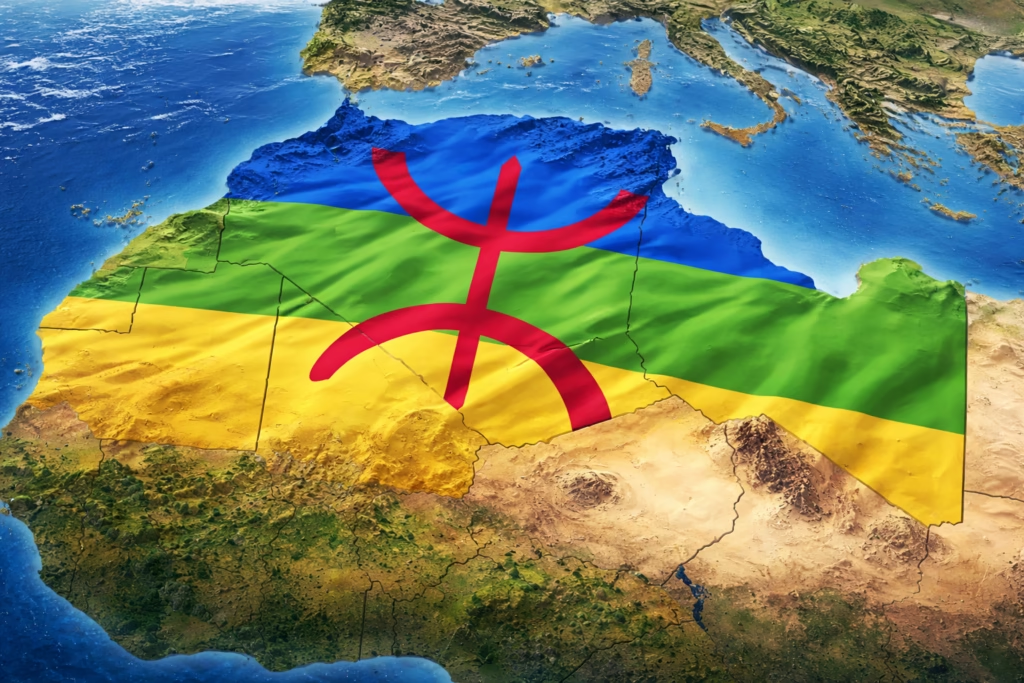
Long before the arrival of foreign powers, the land was inhabited by the Berbers, who refer to themselves as the Imazighen (the “Free People”). Their presence in the Maghreb dates back to the Neolithic period, evidenced by sophisticated Rock art and Petroglyphs found throughout the Atlas Mountains and the Draa Valley.
These early societies were organized into complex Tribal confederations. Their spirituality was rooted in Animism, honoring the natural world through the construction of Tumuli and Megaliths. The Libyco-Berber script, the ancestor of modern Tifinagh, proves that ancient Morocco was home to a literate and culturally distinct population long before the written records of the Mediterranean arrived.
The Imazighen were masters of their environment. In the harsh terrains of the High Atlas, they built fortified granaries and communal dwellings, while in the southern reaches, they managed the oases of the Draa Valley. This deep connection to the land allowed them to maintain a degree of autonomy even when vast empires claimed their territory on maps.
The Age of Antiquity: Phoenicians and Carthaginians
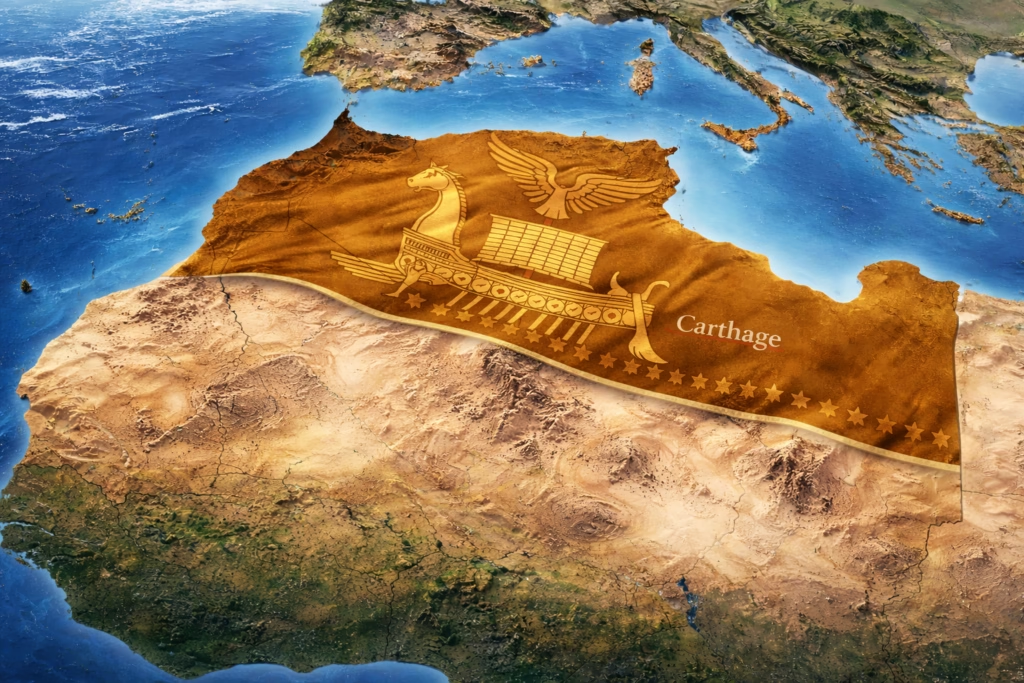
As a coastal powerhouse, ancient Morocco naturally attracted Mediterranean traders. The Phoenicians, the legendary navigators of the Levant, were the first to establish permanent outposts along the Atlantic and Mediterranean coasts. These were not initially meant for conquest, but as vital links in a trade network stretching from Tyre to the Atlantic.
The Foundations of Maritime Trade
Key settlements included:
- Lixus: Famous for its salt-harvesting and fish-processing.
- Mogador: Located at modern-day Essaouira, it was a hub for the Purple dye (murex) industry.
- Tingis: The modern Tangier, serving as the northern sentinel of the Strait of Gibraltar.
Following the Phoenicians, the Carthaginians expanded these settlements, integrating the region into their vast maritime network. Cotta, Zilil, and Tamuda became vital hubs for the exchange of African goods—such as ivory and exotic animals—for Mediterranean pottery and textiles. This era solidified Morocco’s role in the global economy of the time, centered around the Pillars of Hercules.
Mauretania Tingitana: Rome’s Western Frontier
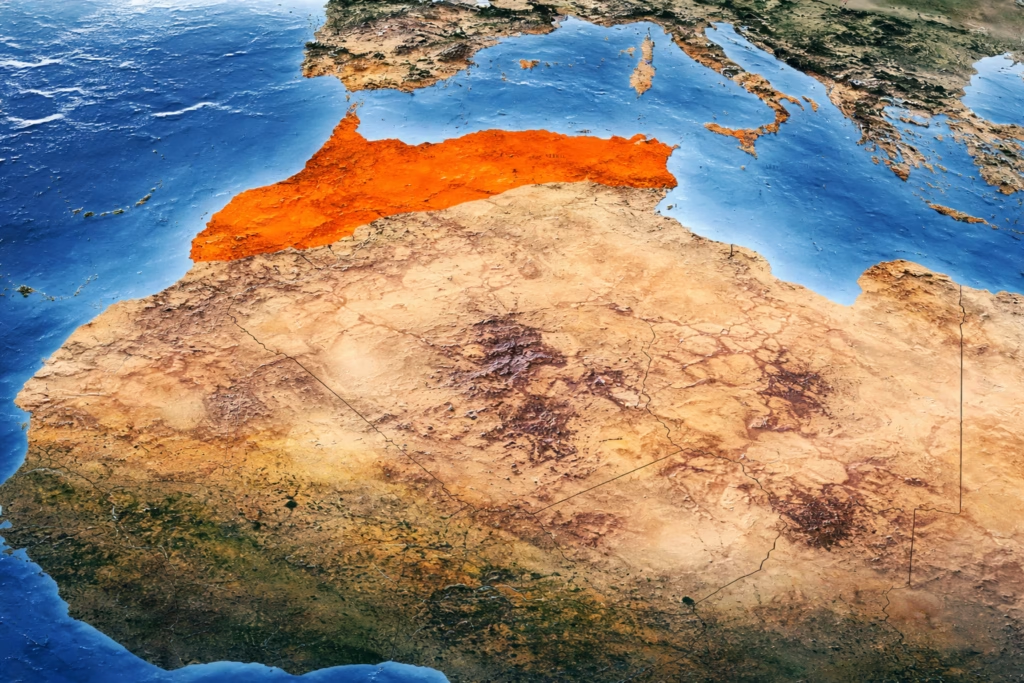
The Roman era remains one of the most visible layers of Morocco ancient history. In 40 AD, after the assassination of Ptolemy of Mauretania by Caligula, the region was formally annexed as the Roman province of Mauretania Tingitana.
The Reign of Juba II and Cleopatra Selene II
Before direct Roman rule, the region flourished under the scholar-king Juba II and his wife Cleopatra Selene II (daughter of the famous Cleopatra VII of Egypt). Juba II was a Renaissance man of antiquity, a scientist and historian who turned his capital into a center of Hellenistic culture. He promoted the Olive oil trade and sponsored expeditions to the Canary Islands.
The Zenith of Volubilis
During this era, cities like Volubilis, Sala Colonia (now Chellah), Banasa, and Thamusida reached their peak. Volubilis, located near Meknes, remains the most impressive Roman site in the country. Visitors today can still marvel at the intricate Mosaics depicting mythological scenes, the soaring Arch of Caracalla, and the remains of vast olive presses.
The economy was highly sophisticated, driven by the production of Garum (a fermented fish sauce prized in Rome) and massive grain exports. This wealth supported a diverse population where Early Christianity eventually began to take root alongside traditional Roman and Amazigh beliefs.
The Transition: Vandals, Byzantines, and the Arrival of Islam
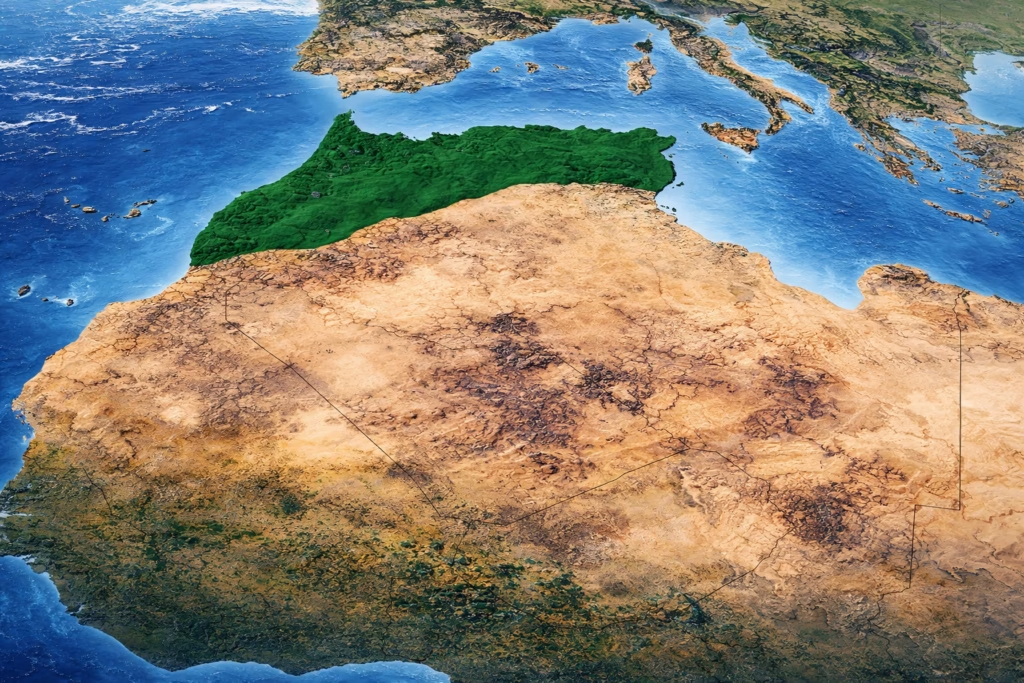
As the Western Roman Empire fractured in the 5th century, the Vandals swept through the region from Iberia. Their occupation was largely coastal and relatively brief, followed by a limited attempt by the Byzantines to reclaim the territory under Justinian.
However, the power vacuum allowed the Mauri (the Latin name for the Moors) to regain control of much of the interior. These independent Moorish kingdoms preserved a mix of Roman administration and Amazigh tribal law until the 7th century, which brought the most significant turning point in the Moroccan history timeline: the Arab conquest.
The Sword and the Word: Islamization
Led by the general Uqba bin Nafi and later solidified by Tariq ibn Ziyad, the Umayyad Caliphate introduced Islam to the region. This was not merely a military shift; it was a social revolution. While the coastal cities were the first to convert, the tribes of the mountains and deserts adopted the new faith on their own terms, blending it with local customs and eventually giving rise to a unique Moroccan Sufism.
The Great Dynasties and the Rise of the Empire of Morocco
The true birth of a unified, sovereign Moroccan state began with the Idrisid Dynasty. Idris I, a descendant of the Prophet Muhammad, fled the Abbasids in the East and was welcomed by the Amazigh tribes of the Middle Atlas.
The Birth of Fez
Idris I and his son, Idris II, founded the city of Fez, which became the spiritual and intellectual heart of the Empire of Morocco. This period saw the stabilization of the region and the beginning of a golden age of architecture and urban planning, characterized by the development of the Medina.
The Almoravids: Veiled Lords of the Sahara
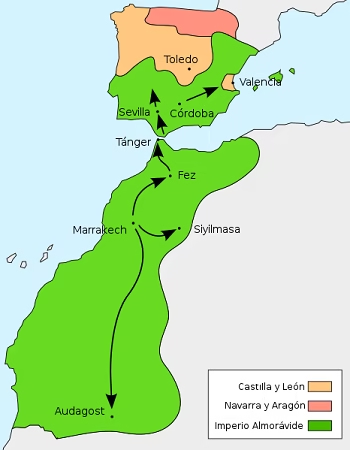
In the 11th century, a group of Saharan nomads known as the Almoravids rose to power. Led by the visionary Yusuf ibn Tashfin, they founded Marrakech and established a dominion that stretched from the Senegal River to the Ebro in Spain. They controlled the Trans-Saharan trade routes through the legendary city of Sijilmasa, where Caravans traded gold for salt, enriching the empire beyond measure.
The Almohads and the Peak of Power
The Almohads, a reformist movement under Yaqub al-Mansur, eventually overthrew the Almoravids. They were master builders, leaving behind iconic structures like the Koutoubia Mosque in Marrakech and the Hassan Tower in Rabat. Under the Almohads, the Empire of Morocco became the most powerful state in the Islamic West, projecting power across the Mediterranean and deep into the Maghreb.
The Marinids, Wattasids, and the Saadi Zenith
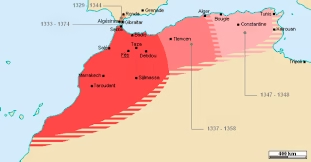
As the Almohad Caliphate declined, the Marinids took the mantle of leadership. They are remembered as the patrons of the arts and education, building the exquisite Madrasas (schools) that still adorn Fez. They struggled to maintain the vast territories of their predecessors, eventually giving way to the Wattasids.
The Saadi Dynasty and the Battle of the Three Kings
The Saadi Dynasty emerged in the 16th century to defend Morocco against Portuguese and Ottoman expansion. They famously defeated the Portuguese at the Battle of Alcácer Quibir, a victory that solidified Morocco’s status as a major player on the world stage. They were also responsible for the magnificent Saadian Tombs and the El Badi Palace, showcasing the immense wealth gained from the Trans-Saharan trade and the conquest of the Songhai Empire.
Architecture of Protection: Kasbah and Ksar
Throughout these dynasties, the Moroccan landscape was transformed by the construction of the Kasbah (fortress) and the Ksar (fortified village). These structures, built from red earth and stone, were essential for defending against rival tribes and foreign invaders, and they remain the most iconic symbols of the Moroccan south.
The Path to Modern Sovereignty
While the focus of this exploration is ancient Morocco and its medieval glory, the narrative of the Moroccan people is one of constant pursuit of self-determination. Over the centuries, the nation faced pressures from European colonial powers, specifically France and Spain, leading to the protectorate era in the early 20th century.
When did Morocco become independent?
After decades of resistance and the rise of the nationalist movement—led by both the Sultan (later King) Mohammed V and various political factions—the world often asks: when did Morocco gain independence? The nation officially reclaimed its full sovereignty from France on March 2, 1956, and from Spain shortly thereafter. This marked the end of the colonial era and the return of the Empire of Morocco to its status as a modern, independent kingdom.
The question of when did Morocco become independent is often tied to the “Manifesto of Independence” of 1944, but the 1956 date is the formal international recognition of the kingdom’s return to the world stage as a free agent.
The Enduring Legacy of the Moors
The term Moors has been used historically to describe the inhabitants of Morocco and the wider Maghreb, especially during their 800-year presence in the Iberian Peninsula (Al-Andalus). The cultural exchange during this period was immense. Moroccan scholars, scientists, and architects influenced the European Renaissance, bringing knowledge of mathematics, astronomy, and irrigation.
The Moroccan history timeline is a testament to a culture that refuses to be erased. From the ancient Libyco-Berber script to the vibrant Medina life of today, the continuity of Moroccan identity is profound. The people have successfully integrated the influences of the East and the West without losing their Amazigh soul.
Summary of Key Historical Milestones
| Period | Era / Dynasty | Key Contribution |
| Pre-8th c. BCE | Indigenous Imazighen | Rock art, Tumuli, Tifinagh |
| 8th c. BCE | Phoenicians / Carthaginians | Lixus, Murex dye, Atlantic trade |
| 1st c. CE | Mauretania Tingitana | Volubilis, Garum, Roman law |
| 788 CE | Idrisid Dynasty | Foundation of the first Islamic State and Fez |
| 1040 CE | Almoravid Dynasty | Foundation of Marrakech, control of Sahara Desert |
| 1121 CE | Almohad Dynasty | Grand architecture, Moroccan hegemony in the Maghreb |
| 1956 CE | Modern Independence | Restoration of full sovereignty |
Conclusion: A Living History
Morocco ancient history is not a static list of dates; it is a living legacy. From the Early Christianity that once thrived in Roman forums to the Islamic scholarship that defined the Middle Ages, Morocco has always been a land of pluralism. The resilience of the Amazigh spirit, combined with the strategic importance of the Maghreb, ensured that the Empire of Morocco would remain a central player in world history.
Today, as we look back at the Moroccan history timeline, we see a nation that has survived the Vandals, integrated the Moors, and successfully navigated the complexities of the modern world. Understanding ancient Morocco is essential to understanding the soul of North Africa—a place where the past is never truly gone, but rather woven into the very fabric of the modern kingdom. Whether it is the call to prayer echoing over a Medina or the silence of a Ksar in the Draa Valley, the echoes of the ancestors remain.